The data lifecycle consists of four phases: creation, hot, warm and cold. Information Lifecycle Management (ILM) is a storage strategy that considers these phases. ILM selects the most appropriate storage tier and technology for each phase.
Designing an effective ILM strategy is challenging. Even data stored at lower tiers must be accessible quickly when needed. Furthermore, such data is often subject to company-specific and legal compliance requirements. This demands prudent data retention management.
Information Lifecycle Management: Hot, Warm and Cold Data
The concept of Information Lifecycle Management (ILM) is based on the assumption that data goes through a lifecycle consisting of various phases, depending on how frequently it is used.
- Creation and "hot" phase:
Immediately after creation, the data is current and used in day-to-day operations. During this phase, the data must be accessible quickly. - “Warm” and “cold” phases:
Over time, the recency and frequency of access to the data decrease, first rendering it "warm" and eventually "cold".
The "hot" phase of most data generated by companies is quite short. According to an IDC study, on average, data is no longer considered “hot” after just 30 days and is considered “cold” after another 60 days. Consequently, cold data often consumes a large portion of available storage space, even though it is rarely, if ever, used.
- Active data should be stored on high-performance primary storage.
- Inactive data, however, should be moved to cost-effective secondary storage.
Information Lifecycle Management with PoINT Solutions
Case Study: Max Planck Institute Bad Nauheim
The Max Planck Institute in Bad Nauheim handles data volumes in the petabyte range. In particular, measurement data must be archived for the long term. However, this data is only accessed sporadically. The research institute therefore uses a multi-tier storage architecture with primary and secondary storage.
Our solution, PoINT Storage Manager, automatically moves cold data to the tape-based secondary storage tier according to predefined rules. PoINT Storage Manager also provides features for secure long-term archiving while maintaining transparent data access.
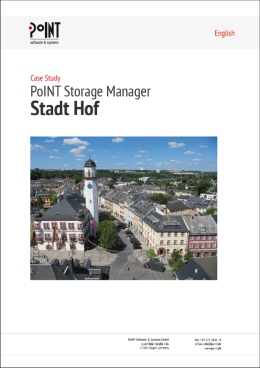
Case Study: Town of Hof
An analysis of the town of Hof revealed that 70% of data stored on its primary systems was no longer in use. This inactive data was more than two years old. In order to free up space by offloading this inactive data, the municipality implemented a two-tier storage architecture and hierarchical storage management using PoINT Storage Manager.
The software solution manages the data lifecycle. It automatically distinguishes between active and inactive data based on predefined policies, moving cold data to secondary storage. The town of Hof can now use its storage infrastructure more efficiently.
Policy-based Migration and Archiving with PoINT Storage Manager
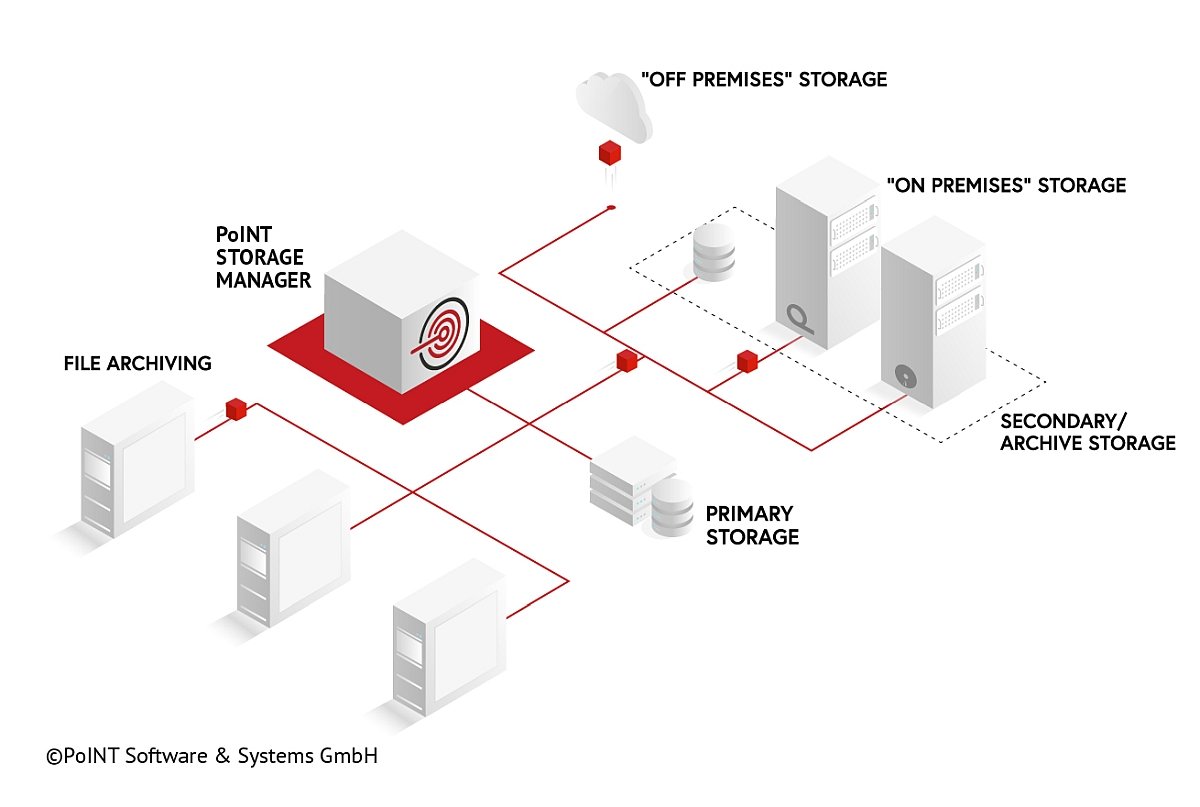
Optimizing storage infrastructure, as well as data and storage management, unlocks potential efficiency gains and cost savings.
PoINT Storage Manager simplifies the implementation of an ILM strategy for companies.
- Lifecycle Policies:
Companies create custom policies for migration and data archiving based on characteristics such as age, access, file size, and file type. - Storage Tiering:
PoINT Storage Manager moves data within a multi-tier storage structure according to these policies. Data is stored on the appropriate storage tier based on factors such as age or last access. - Transparent Read Access Without Restore:
Users can view and access offloaded and archived data via primary storage as they did before, even though the data is stored on secondary storage. Accessing the data does not result in its restoration to primary storage.
Selected Features
- Policy-based storage tiering within a multi-tier storage architecture
- Vendor-neutral support for storage systems
- Administrative deletion of data (e.g., in accordance with GDPR)
- Compliance: WORM protection and retention management protect against tampering and accidental deletion