As data volumes grow, so do storage infrastructures, and this encounters companies with major challenges. Initially, the resources have to be provided and integrated. Cost considerations are usually the first priority here.
However, the increasing data volumes and correspondingly larger infrastructures also lead to higher energy requirements and more CO2 emissions from the data center. Data storage accounts for a large part of the energy consumption. In particular hard disk-based storage systems require a lot of electricity for operation and cooling.
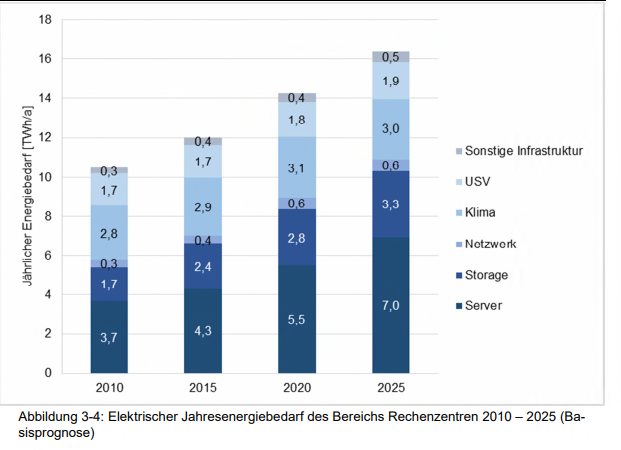
Considerations regarding “green IT” and energy-efficient, low-emission data storage are increasingly gaining prominence. Companies have a considerable responsibility here – and not least a lot of potential for further cost savings.
Data Storage on Hard Disks: Advantages and Limitations
Especially in areas where data volumes are growing particularly fast, companies are turning to hard disk-based storage systems: Data from AI and Machine Learning applications is mostly stored on hard disks – and this is likely to remain the case in the future.
However, there are various reasons to initiate a shift in re-thinking here:
- An increase in capacity is only possible to a limited extent for hard disks. This means that future data growth is much higher than the technically possible increase in capacity. In order to keep pace with the storage capacities accordingly, more hard disks have to be added – which is associated with enormous costs and also energy consumption.
- The energy consumption for operation and cooling of hard disk-based storage systems is comparatively high. SSDs also consume power when no data is being written or read; there is a risk of data loss if they are stored without power for a long time.
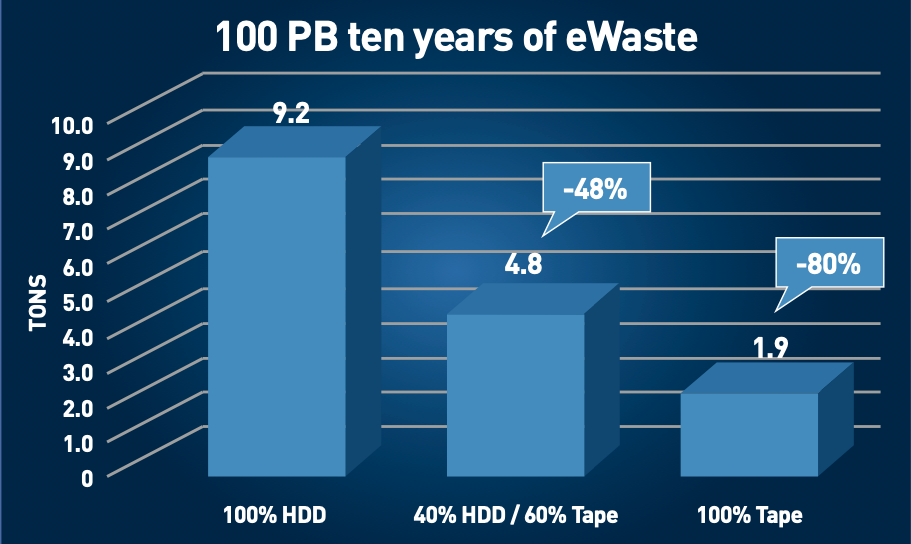
- The lifetime of hard disks is 5 to 10 years. This makes it relatively short compared to other storage technologies. Tapes, for example, can be expected to last 30 years. Especially when it comes to long-term storage of data, e.g. to meet retention periods, the data must be migrated to new storage systems. The old ones inevitably end up as electronic waste.
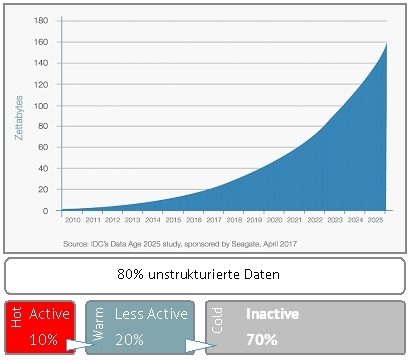
- One of the great advantages of hard disks is their random-access capability and thus their high access speed, which users benefit from as long as the data is still being accessed regularly. But if data is used less and less as it ages, storing it on hard disks is neither technically necessary nor economically and ecologically reasonable.
Tape as a Sustainable and Economical Alternative
Sustainability and economy: these two arguments go hand in hand when it comes to an alternative to hard disks. Hard disks can provide short access times – but at the same time, there are more cost- and energy-efficient ways of storing so-called “cold data” in particular, which is only rarely used or not used at all. This is because the access speed offered by hard disks is no longer the decisive criterion here.
This also applies to data that is generated in machine learning applications, for example, and is not evaluated immediately but is to be stored for later use.
This is where the storage medium tape scores points – both in terms of cost-effectiveness and sustainability:
- Tape offers a favorable price per TB of storage. Investment protection is provided by the LTO standard and the clear roadmap that provides for a steady increase in capacity.
- Tape libraries consume significantly less power during operation than hard disks. They also generate hardly any waste heat, which reduces the energy required for cooling to a minimum.
- The warehousing of tapes also requires only a small amount of energy. If tapes are stored dry and at room temperature, their lifetime is at least 30 years. The long durability means that migrations need to be carried out less frequently or not at all, because the lifetime of the storage medium covers the prescribed retention period. This also results in less electronic waste.
Integration of Tape Technology through Software-Defined Storage
Due to its specific properties, tape technology can make a decisive contribution to reducing the energy consumption and CO2 emissions of the data center. If tape is to be used for the aforementioned use cases, intelligent, software-based integration is required.
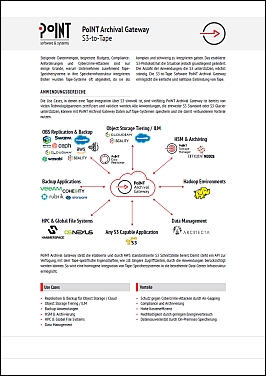
This challenge is solved by a software-based object storage that receives data via the standardized S3 interface and writes it directly to tape. In this way, tape can be seamlessly integrated into the infrastructure as an S3 storage class, and users can benefit from the advantages of the technology.
PoINT Archival Gateway offers such a solution. The software provides the necessary interface to the applications and manages the data storage on tape, under the specific conditions of the technology.
This approach enables the use of tape technology for a large number of use cases. Companies benefit comprehensively from the cost efficiency and sustainability of tape as a storage medium.
- If less hard disks are used for data storage, power consumption and emissions from the storage infrastructure can be reduced significantly.
- In addition, companies can take advantage of the typical security features of the technology – such as WORM protection and Air Gap.